
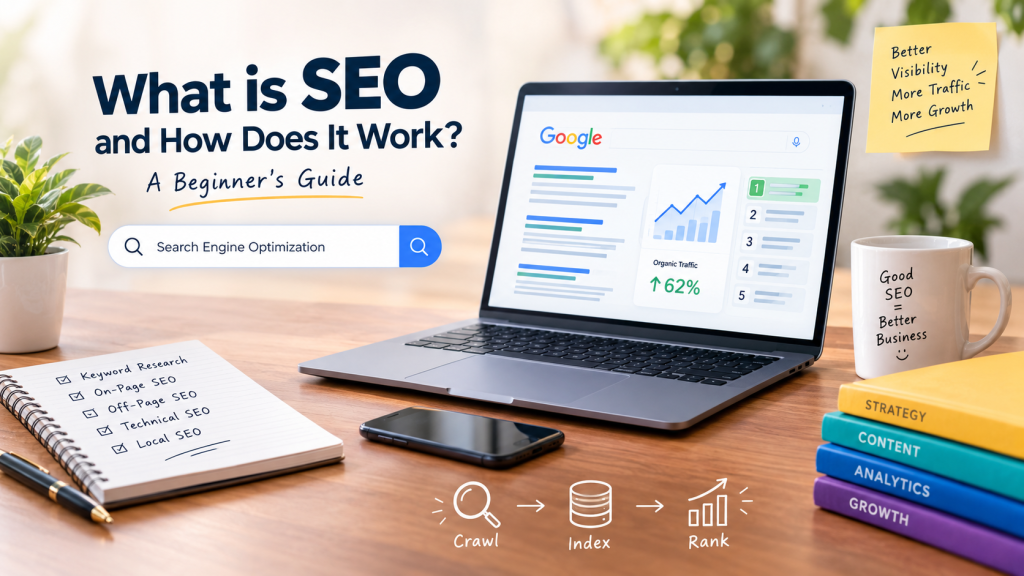
What Is SEO?
SEO stands for Search Engine Optimization. It is the process of improving a website so that search engines like Google can understand its content and show it to people searching for relevant information.
For example, imagine you own a digital marketing agency in Lucknow. When someone searches for “digital marketing services in Lucknow,” you want your website to appear among the relevant search results. SEO helps improve your chances of appearing for searches related to your services.
SEO focuses on earning organic traffic, which means visitors who find your website through unpaid search results.
However, SEO is not just about ranking higher on Google. It is also about providing useful information, improving the user experience, and helping people find exactly what they need.
How Does SEO Work?
Search engines use automated systems to discover, understand, and rank web pages. SEO helps your website become easier for these systems to access and understand.
Here is how the process works.
1. Crawling
Search engines use automated programs called crawlers to discover pages across the internet. They follow links from one page to another and collect information about website content.
If your website has clear navigation, working links, and accessible pages, search engines can generally discover its content more easily.
2. Indexing
After discovering a page, Google may analyze its text, images, videos, and other information to understand what the page is about.
Google can then store the page in its index, which is a large database of information about web pages.
A page must generally be indexed to appear in Google’s search results. However, discovering a page does not guarantee that Google will index it.
3. Ranking
When someone searches for information, Google evaluates many signals to determine which results are most relevant and useful for that particular search.
These signals can include the meaning of the query, content relevance, content quality, page usability, and the context of the search.
For example, if someone searches for “how to improve website SEO,” Google tries to show pages that answer that question clearly and accurately.
Important: SEO does not guarantee a first-page ranking. Search engines control their ranking systems, and results can change over time.
What Are the Main Types of SEO?
SEO is commonly divided into several categories. Each one focuses on a different aspect of website optimization.
1. On-Page SEO
On-page SEO involves optimizing the content and HTML elements of individual web pages.
Important on-page SEO practices include:
- Keyword research: Understanding the words and phrases your target audience searches for.
- Title tags: Writing clear, descriptive page titles.
- Meta descriptions: Creating useful summaries that may appear in search results.
- Headings: Organizing content with appropriate H1, H2, and H3 headings.
- Internal linking: Linking related pages on your website.
- Image optimization: Using descriptive file names and relevant alternative text.
- Quality content: Publishing original, helpful, and easy-to-understand information.
For example, a blog about social media marketing should explain the topic in depth and use relevant phrases naturally rather than repeating the same keyword unnecessarily.
2. Off-Page SEO
Off-page SEO refers to activities outside your website that can help establish its reputation and authority.
Common examples include:
- Earning backlinks from relevant, trustworthy websites.
- Building relationships with industry publications and creators.
- Promoting useful content through appropriate channels.
- Maintaining accurate business information across relevant directories.
Backlinks are links from other websites to your website. They can help search engines discover pages and provide signals of credibility when earned naturally.
Avoid buying spammy links or participating in link schemes. Such tactics can violate search engine spam policies.
3. Technical SEO
Technical SEO focuses on making your website easier for search engines to crawl, understand, and index, while also improving the experience for visitors.
Key areas include:
- Website loading speed and performance.
- Mobile-friendly design.
- Secure browsing through HTTPS.
- XML sitemaps.
- Correct use of canonical URLs.
- Fixing broken links and server errors.
- Managing duplicate pages.
- Reviewing indexing issues in Google Search Console.
For example, if important pages are blocked from crawling or marked with a noindex directive, they may not appear in search results as expected.
4. Local SEO
Local SEO helps businesses become more visible in searches related to a particular location.
It is especially useful for restaurants, clinics, shops, agencies, and other businesses that serve customers in specific areas.
For example, a business may want to appear for searches such as:
- Digital marketing agency in Lucknow
- Best salon near me
- Website designer in Uttar Pradesh
To improve local SEO, businesses can:
- Create and maintain a Google Business Profile if eligible.
- Keep their name, address, and phone number accurate.
- Choose relevant business categories.
- Add genuine photos and useful business information.
- Encourage authentic customer reviews.
- Create helpful location-specific website content where appropriate.
Local SEO helps potential customers discover businesses when they are looking for nearby products or services.
Why Are Keywords Important in SEO?
Keywords are the words and phrases people enter into search engines. They help you understand what your audience wants to find.
For example, someone searching for “what is SEO” probably wants basic information, while someone searching for “SEO services for small businesses” may be comparing service providers.
These searches show different intentions.
Before writing content, research the terms your audience uses and understand the purpose behind each search.
You can use tools such as Google Keyword Planner, Google Trends, and Google Search Console to research search terms and understand performance.
Remember, keyword research is not about inserting as many keywords as possible. It is about creating content that answers the searcher’s question naturally and completely.
What Is the Difference Between SEO and Paid Advertising?
SEO and paid advertising can both help businesses reach people online, but they work differently.
| SEO | Paid Advertising |
|---|---|
| Focuses on organic search visibility | Uses paid placements |
| Does not charge for each organic click | Often charges per click or impression |
| Results can take time to develop | Campaigns can start generating visibility quickly |
| Can generate traffic over the long term | Traffic often decreases when campaigns stop |
| Requires ongoing optimization | Requires budget and campaign management |
Neither approach is automatically better for every business. SEO can help build long-term organic visibility, while paid advertising can support faster promotion and targeted campaigns.
Many businesses use both strategies together.
How Long Does SEO Take to Show Results?
SEO is a long-term process, and results do not usually appear overnight.
The time required depends on factors such as your website’s current condition, competition, content quality, technical issues, and the search terms you are targeting.
Some improvements may produce noticeable results sooner, while competitive keywords can require sustained work over many months.
A sensible SEO strategy focuses on consistent improvements rather than expecting immediate first-page rankings.
Track progress using measures such as:
- Organic clicks and impressions.
- Keyword visibility.
- Relevant website traffic.
- Leads, enquiries, and sales.
- Engagement with important landing pages.
The ultimate goal is not simply to attract more visitors. It is to attract the right visitors who may become customers.
Common SEO Mistakes You Should Avoid
Many website owners make avoidable mistakes that limit their SEO performance.
1. Keyword stuffing: Repeating keywords unnaturally makes content difficult to read and may violate spam policies.
2. Publishing low-quality content: Content created only to attract search traffic often fails to provide real value.
3. Ignoring mobile users: A website should be easy to navigate on smartphones as well as computers.
4. Neglecting technical problems: Broken pages, indexing issues, and poor navigation can affect discoverability and usability.
5. Expecting instant results: SEO requires monitoring, testing, and regular improvement.
6. Copying content from other websites: Publishing original, useful material is a better long-term strategy than duplicating existing articles.
7. Ignoring performance data: Without reviewing search performance and user behaviour, it is harder to identify what needs improvement.
How Can Beginners Start Learning SEO?
If you are new to SEO, you do not need to master everything at once. Start with the basics and gradually build your skills.
Here is a practical roadmap:
- Learn how search engines crawl, index, and rank web pages.
- Understand keyword research and search intent.
- Practice writing useful, well-structured content.
- Learn on-page SEO, including titles, headings, and internal links.
- Set up Google Search Console to monitor your website’s search performance.
- Improve technical SEO and mobile usability.
- Study analytics and measure meaningful results.
- Keep learning as search engine systems and best practices evolve.
If you use WordPress, you can also explore SEO plugins such as Yoast SEO or Rank Math to help manage titles, meta descriptions, sitemaps, and other optimization tasks. Remember that installing a plugin alone does not guarantee better rankings.
Conclusion
SEO is an essential part of digital marketing because it helps people discover your website when they search for information, products, or services. It works through a combination of content optimization, technical improvements, website credibility, and a better user experience.
The best approach is to focus on your audience, publish genuinely helpful content, and improve your website consistently. Rankings may take time, but a well-planned SEO strategy can help your business build visibility, attract relevant visitors, and create opportunities for long-term growth.
At Neelam Creation, we believe that a strong online presence begins with the right digital strategy. Understanding SEO is an important first step toward making your website more discoverable and helping your business reach the right audience.
Ready to improve your website’s visibility? Explore digital marketing strategies that can help your business grow online.